Xentent PXM is an enterprise product experience management platform that unifies product data in a single Fragment model, governs it through Schema templates and Family attribute sets, and orchestrates omnichannel publishing, localization and natural-language product sourcing from one source of truth.
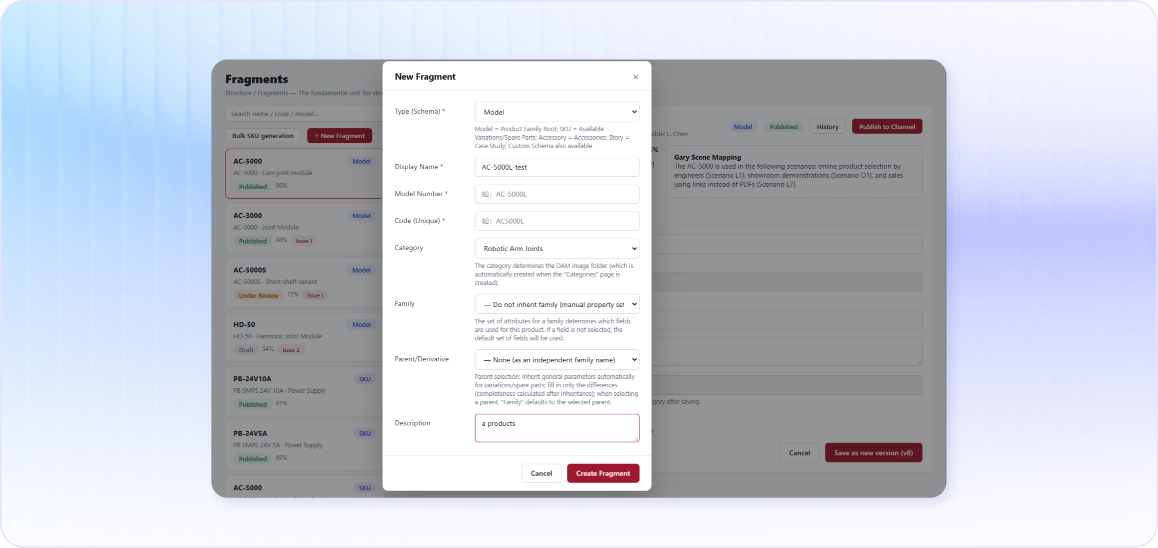
Model, SKU, accessory and application story are the same kind of object — something that can be approved, translated, published and searched. Schema defines the structural skeleton for each Fragment type, Family defines the attribute set a product class must carry. Model once, reuse everywhere: introducing a new product type means creating a Schema, not rewriting the publishing engine, the approval flow or the search pipeline.
Every field is defined once in a global attribute library — type, unit, enum, translatable flag, channel-output flag — and Families bundle those fields into attribute sets for a product class, while individual products can still add or drop fields. New variants inherit the parent's attribute set and values automatically, so one parameter change propagates everywhere and channel data can never silently drift apart.
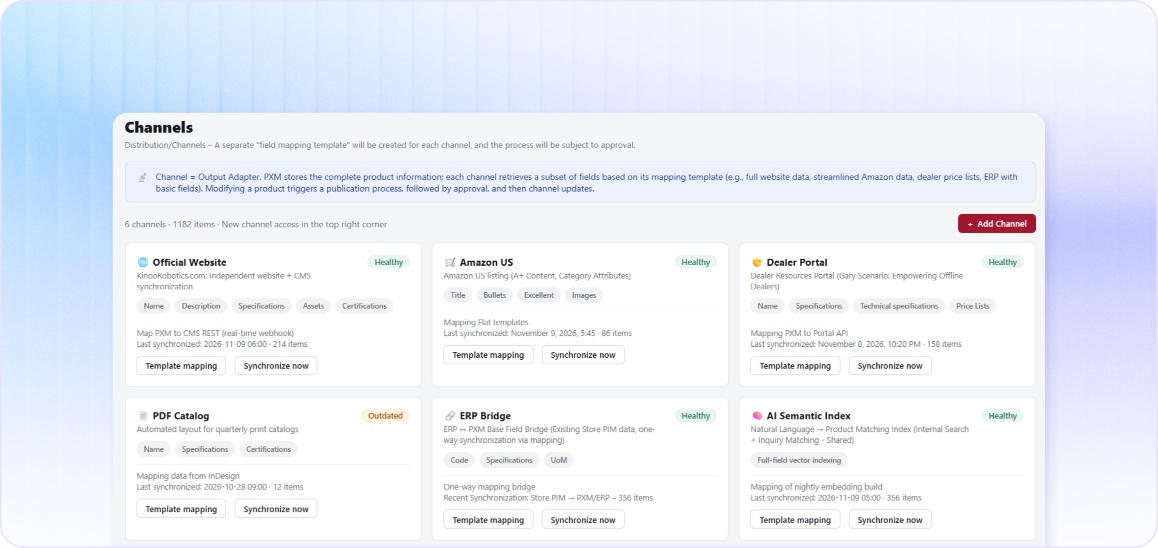
Six built-in channels — website, Amazon, dealer portal, PDF catalog, ERP bridge and AI semantic index — each with its own field-mapping template and transformation rules. Publishing runs on tickets: approvers review the final channel-view value, incomplete products are blocked, and a channel that stops syncing is flagged stale and surfaced on the dashboard.
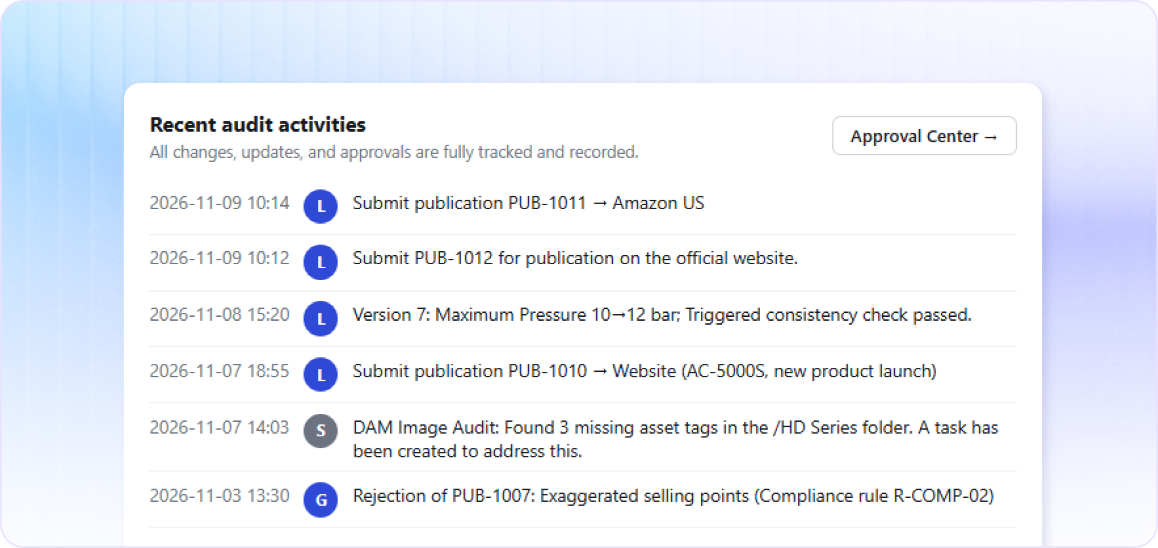
Approval tickets, version snapshots, field-level change history, 30-day soft delete with restore, plus granular permissions and an authorization center form a complete security loop. Schema and attribute libraries evolve in compatibility mode: new fields apply to existing data without blocking publication, and deletions are gated by reference counting.
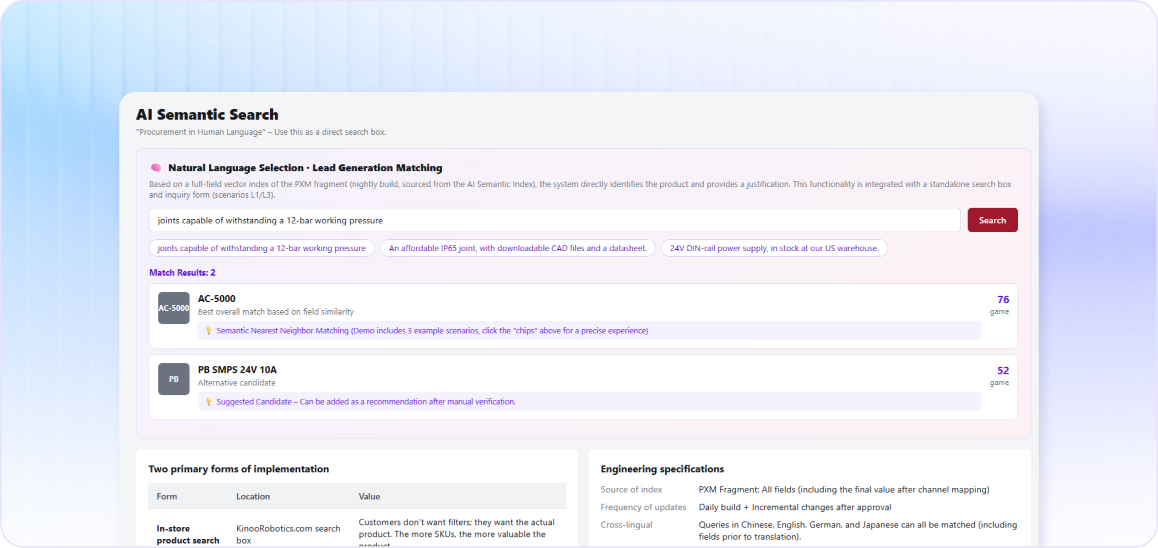
Customers describe what they need in natural language and get ranked product matches, each with the reason it matched and a confidence score; below-threshold models are not recommended by default but stay available for manual override. AI translation writes missing locales straight into the master record, and a human edit simply overrides it. The semantic index ingests approved content only, so search returns what was actually published.
Xentent-PXM is integrated with the DAM platform rather than operating beside it. Creating a category in PXM instantly creates the mirrored folder in DAM; uploading an asset mounts it on the linked product and back-fills the asset field; mirrored folders stay read-only in DAM. When an asset is deleted or invalidated, consistency checks raise an issue and deduct completeness.
Target languages follow distribution, not spreadsheets: publish to a channel and the required locales are derived automatically, with no hand-maintained mapping table. Untranslated fields fall back to the base language and are flagged at publish time, so a customer never meets a blank field. A weighted coverage dashboard highlights gaps and offers one-click completion.
Every product is a Fragment, and a Model roots the tree that derives SKUs, accessories and application stories beneath it — shared parameters cascade down, each variant overrides only what differs. Schema locks identity fields, Family defines business attributes, structure stays separate from content. New product types extend with zero code, and one parameter change follows through every variant and channel.
Intelligent Product Lifecycle
Saving creates a version, any two versions can be diffed field by field and rolled back, and completeness is computed live as a hard publication gate. Publishing, approval, rejection and resubmission all flow through auditable tickets, turning "who changed which parameter to what, and when" into an auditable fact.
Multichannel Orchestration & Consistency
Each of the six built-in channels — website, Amazon, dealer portal, PDF catalog, ERP bridge and AI semantic index — owns its own mapping template and transformation rules, with manual sync-now and health monitoring that flags stale channels. Consistency checks turn missing assets and broken references into trackable issues. Omnichannel is not multiple copies of data; it is multiple projections of one.
AI-Enhanced Product Experience
Natural-language sourcing lets customers find products in their own words across multilingual fields, on a standalone search page or inline in forms, with a match reason and confidence score on every hit. AI translation fills missing locales directly and human edits override it, while the semantic index ingests approved content only — making search results the published truth. Governance effort becomes a customer-visible outcome: findable, understandable and correctly matched.
Application Scenarios
01Multi-Specification Variant Management
Brands need every size and color combination created at once. Xentent-PXM generates all variants from one parent Model, inheriting its attributes and values.
02Omnichannel Listing Consistency
03Multilingual Market Expansion
04Natural-Language Product Sourcing
Product Management
Attribute & Schema Management
Governance & Security
Channel & Publishing Management
Localization & AI Intelligence
DAM Integration
Fragment Carrier
Attribute Library
Completeness Rules
Six Built-in Channels
Target-Language Derivation
Asset Mounting
Schema Template
Field Types & Units
Approval Tickets
Mapping & Transformation Rules
Translation Workspace & AI Write
Asset Field Back-Fill
Family Attribute Set
Enums & Groups
Version Snapshots
Channel-View Diff
Base-Language Fallback
Read-Only Mirrors
Model & SKU Variant
Translatable Flag
Change History & Audit
Completeness Blocking
Coverage Dashboard
Asset Consistency Check
Accessories & Stories
Channel-Output Flag
Permission & Authorization
Resubmit & Republish
Natural-Language Sourcing
Asset Invalidation Alerts
Category & Hierarchy
Attribute Set Editing
Deletion Protection
Sync Now & Health Monitor
Semantic Index
Inheritance & Bulk Variants
Schema Compatibility
Soft Delete & Restore
ERP Bridge & Print Catalog
Multi-Surface Search
Relevant Cases
Ford and Lincoln China Official Website
A visual editing-based content management platform for automotive brand official websites